Supreme Court confirms Exxon’s liability in 16-year clean air citizen suit

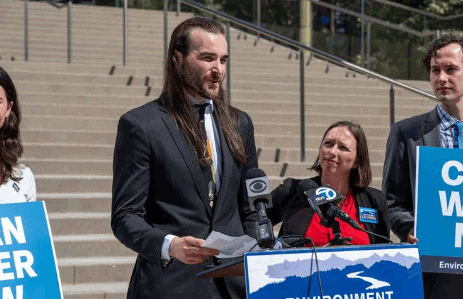
WASHINGTON, D.C.—On June 30, the U.S. Supreme Court closed ExxonMobil Corporation’s last possible avenue for appeal, putting a long overdue stamp of finality on a landmark judgment won by Environment Texas and the Sierra Club against the fossil fuel giant.

After a 16-year legal battle, Exxon must finally pay a $14.25 million penalty for committing more than 16,000 violations of the federal Clean Air Act at its Bay- town, Texas, refinery and chemical complex—the largest penalty imposed after trial in any citizen-initiated case to enforce the Clean Air Act or Clean Water Act.

More importantly, the lawsuit spurred Exxon to spend nearly a billion dollars on safety and pollution reduction measures at its sprawling 3,400-acre Baytown complex, in an effort to cut down on the notorious “emission events” that spewed over 10 million pounds of illegal pollution into surrounding neighborhoods over the eight-year period covered by the lawsuit.

“This wasn’t just a court case,” said NELC’s Boston Office Managing Attorney Josh Kratka. “This was a fight for the right of regular people to breathe clean air and to hold even the world’s largest corporations accountable when they interfere with that right.”

Four courageous Baytown residents testified at trial that they endured persistent and terrifying flaring events, toxic chemical leaks, massive industrial fires, and foul odors from the nearby oil refinery and chemical plants run by Exxon. NELC attorneys proved, through expert testimony and many thousands of pages of evidence, that Exxon exposed people to illegal emissions of 24 different pollutants, from cancer-causing chemicals to respiratory irritants.

But even after Exxon’s lead attorney admitted, in response to a direct question from the judge on the last day of trial, that the company had indeed violated the emission limits in its permits many thousands of times, Exxon proceeded to spend nine years filing ap- peals, in an attempt to escape responsibility for its actions.

Exxon’s argument? That regular people who are harmed by the continuing threat of illegal pollution somehow don’t have enough of a personal stake in the case to give them the legal standing to seek the imposition of penalties that will deter future violations. That’s why one Fifth Circuit judge called this “an important case that impacts not only Exxon but also standing doctrine and environmental law more generally.”

The result? Exxon lost four times in front of the usually business-friendly Fifth Circuit Court of Appeals, and was then unable to persuade the U.S. Supreme Court to review those decisions.

The moral? Persistence, commitment, and the truth of incontrovertible facts can—and must—prevail against even the most well-heeled polluters and their vast legal teams.  

Previous Story Next Story

Los Angeles Harbor to be cleaner following NELC settlement of lawsuit over Port’s pollution

LOS ANGELES—On June 10, U.S. District Court Judge Consuelo B. Marshall entered a judgment approving the settlement of a lawsuit filed by NELC Staff Attorney Lewis DeHope against the City of Los Angeles for violations of the federal Clean Water Act at the Port of Los Angeles.

The lawsuit, filed in July 2024 on behalf of Environment California, alleged years of pollutant discharge violations from a stormwater treatment system that was both ineffective and undersized for the types and amounts of contaminated water accumulating at the sprawling Port.

The agreement fosters improved water quality in two major ways. First, it requires an end to longstanding violations of limits on discharges of bacteria and copper. Compliance with those limits will be accomplished through a required overhaul of the Port’s treatment system, and through enhanced monitoring practices to confirm the effectiveness of the planned improvements.

Second, the settlement requires a payment of $1.3 million to the Rose Foun- dation for Communities and the Environment to fund projects aimed at re- storing the Los Angeles Harbor, with most funds earmarked for a multi-year effort to remove tons of trash from San Pedro Bay. The agreement also requires the payment of a $130,000 civil penalty for past violations.

Previous Story Next Story

NELC brokers agreement with Bayer subsidiary to improve air emissions reporting

SODA SPRINGS, ID—In March, following a notice of violation served on the company by NELC attorneys, Idaho Conservation League and Environment America reached an agreement with Bayer-owned P4 Production that will improve the reporting of excess emissions at the company’s phosphorus production plant in Southeast Idaho.

The company has already begun complying with its Clean Air Act permit by accurately disclosing the types and amounts of pollutants it releases during “upset” emissions and is working to fill in missing information from past reports.

Additionally, P4 will continue to develop its methodology for estimating emissions, allowing the surrounding community to stay better informed about the air they breathe.

Idaho Conservation League and Environment America also reached a separate agreement with P4 in June to fund improvements to a migratory corridor crucial to the survival of the Soda Hills mule deer herd.

Mule deer follow the same migratory routes year after year, and have difficulty adapting when residential and industrial development threaten their preservation. P4’s $50,000 gift will allow the Idaho Department of Fish and Game to create a safer wildlife corridor between the herd’s summer and winter ranges.

Previous Story Next Story

Settlement in Clean Water Act suit sets powerful precedent for future litigation against plastic polluters

PITTSBURGH—At a Sept. 4 press conference, NELC Senior Attorney Matt Donohue joined representatives of PennEnvironment and Three Rivers Waterkeeper to announce a groundbreaking settlement in the groups’ Clean Water Act citizen suit against Styropek USA. NELC attorneys filed the case in October 2023, after securing evidence that the wastewater and stormwater discharged by Styropek’s aging facility into Raccoon Creek, a tributary of the Ohio River, routinely contained countless small plastic pellets (or “nurdles”) manufactured on site.

An estimated 10 trillion nurdles make their way into marine ecosystems each year. Much of this loss occurs at manufacturing facilities like Styropek, which tend to be located in places with well-developed petrochemical industries, like Western Pennsylvania and the Gulf Coast.

Lost nurdles present an outsize risk to the environment as they migrate along rivers and streams towards the ocean. Even purportedly non-toxic nurdles act as “toxic sponges,” attracting hydrophobic chemical toxins and bacteria and transporting them throughout aquatic environments. Studies establish that hundreds of fish species ingest such plastics, which then enter the food chain of humans and other animals.

To combat nurdle loss at the Styropek facility, NELC attorneys deployed the Clean Water Act (CWA)’s prohibition against the “unpermitted discharge” of pollutants. Put simply, since Styropek’s CWA permit does not expressly allow the discharge of nurdles, the company violates its permit every time nurdles escape in its wastewater or stormwater. Although a similar strategy could be pursued against most large plastic facilities, it is often extremely difficult to document nurdles escaping a facility.

NELC attorneys hope the Styropek settlement will make gathering evidence for future enforcement cases less onerous. As part of the agreement, Styropek must completely redesign its outdated stormwater collection and treatment systems to capture all nurdle waste, a monumental task given that the facility is located on a 400-acre tract of land.

To accomplish it, the company will install cutting edge monitoring technology at every stormwater outfall. These new monitors can intercept and log each nurdle that would otherwise slip unnoticed into a public waterway, and Styropek will pay a penalty each time a nurdle is captured.

Taken together, noted NELC’s Donohue, the terms of the settlement establish the precedent that, when properly motivated, companies like Styropek are willing and able to operate under a strict “no plastic discharge” standard.

Styropek must also make $2.6 million in payments: $2 million will be set aside to remediate pellets in the immediate vicinity of the Styropek facility, $500,000—plus any unused remediation money—will go toward improving the Raccoon Creek/Ohio River watershed, and the remaining $100,000 will be paid to the Pennsylvania Clean Streams Fund.  

Previous Story Next Story

Meet Cora Hagens, NELC’s newest staff member

BOSTON—In June, we welcomed new paralegal and office administrator Cora Hagens to the NELC team.

Cora graduated from Yale University in 2024 with a B.A. in cognitive science and a concentration in environmental psychology. While at Yale, she conducted research on climate change perception, studying how an individual’s political environment shapes their belief in our ability to address climate change.

She is excited to contribute to NELC’s work holding polluters accountable through citizen enforcement suits, which translate individual environmental concern into meaningful legal and environmental outcomes.

“I’m thrilled to be joining NELC,” Cora said. “It’s a privilege to be able to learn from such great people, and to contribute to work that strives to make impactful, positive change.”

When she’s not in the office, Cora moonlights as a choral musician, performing sacred and secular works with ensembles across the Northeast. Although she’s sung in cathedrals and concert halls all over the world, her favorite performance venue remains her own shower in Cambridge, Massachusetts.

Cora replaces Lauren Justice, who served as NELC’s paralegal since January 2024 and will be starting law school at UC Davis this fall. Thank you, Lauren!

Previous Story Next Story