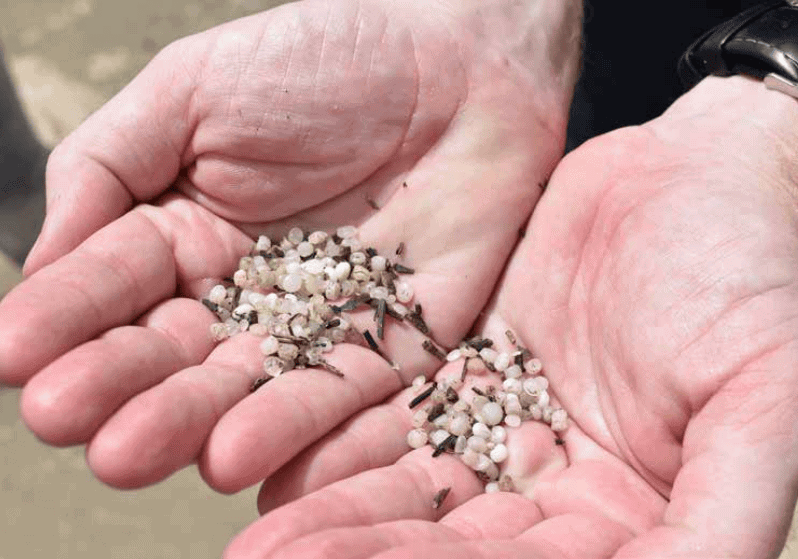
PITTSBURGH—At a Sept. 4 press conference, NELC Senior Attorney Matt Donohue joined representatives of PennEnvironment and Three Rivers Waterkeeper to announce a groundbreaking settlement in the groups’ Clean Water Act citizen suit against Styropek USA. NELC attorneys filed the case in October 2023, after securing evidence that the wastewater and stormwater discharged by Styropek’s aging facility into Raccoon Creek, a tributary of the Ohio River, routinely contained countless small plastic pellets (or “nurdles”) manufactured on site.
An estimated 10 trillion nurdles make their way into marine ecosystems each year. Much of this loss occurs at manufacturing facilities like Styropek, which tend to be located in places with well-developed petrochemical industries, like Western Pennsylvania and the Gulf Coast.
Lost nurdles present an outsize risk to the environment as they migrate along rivers and streams towards the ocean. Even purportedly non-toxic nurdles act as “toxic sponges,” attracting hydrophobic chemical toxins and bacteria and transporting them throughout aquatic environments. Studies establish that hundreds of fish species ingest such plastics, which then enter the food chain of humans and other animals.
To combat nurdle loss at the Styropek facility, NELC attorneys deployed the Clean Water Act (CWA)’s prohibition against the “unpermitted discharge” of pollutants. Put simply, since Styropek’s CWA permit does not expressly allow the discharge of nurdles, the company violates its permit every time nurdles escape in its wastewater or stormwater. Although a similar strategy could be pursued against most large plastic facilities, it is often extremely difficult to document nurdles escaping a facility.
NELC attorneys hope the Styropek settlement will make gathering evidence for future enforcement cases less onerous. As part of the agreement, Styropek must completely redesign its outdated stormwater collection and treatment systems to capture all nurdle waste, a monumental task given that the facility is located on a 400-acre tract of land.
To accomplish it, the company will install cutting edge monitoring technology at every stormwater outfall. These new monitors can intercept and log each nurdle that would otherwise slip unnoticed into a public waterway, and Styropek will pay a penalty each time a nurdle is captured.
Taken together, noted NELC’s Donohue, the terms of the settlement establish the precedent that, when properly motivated, companies like Styropek are willing and able to operate under a strict “no plastic discharge” standard.
Styropek must also make $2.6 million in payments: $2 million will be set aside to remediate pellets in the immediate vicinity of the Styropek facility, $500,000—plus any unused remediation money—will go toward improving the Raccoon Creek/Ohio River watershed, and the remaining $100,000 will be paid to the Pennsylvania Clean Streams Fund.
